
Published 2024-11-18
To quantify mineable aggregate reserves, I begin with a thorough understanding of the deposits geology and the data available on it. This starts with drilling, test pits, mapping and geophysical methods. After data collection I have appropriate quality tests done at a lab and other data synthesized so it can be used in a GIS (Geographic Information System). Data points from exploration provide information on the thickness and quality of both the aggregate and overburden layers. Overburden, which is the material lying on top of the aggregate, needs to be stripped away before mining, so accurately calculating its volume is essential for planning and cost estimation.
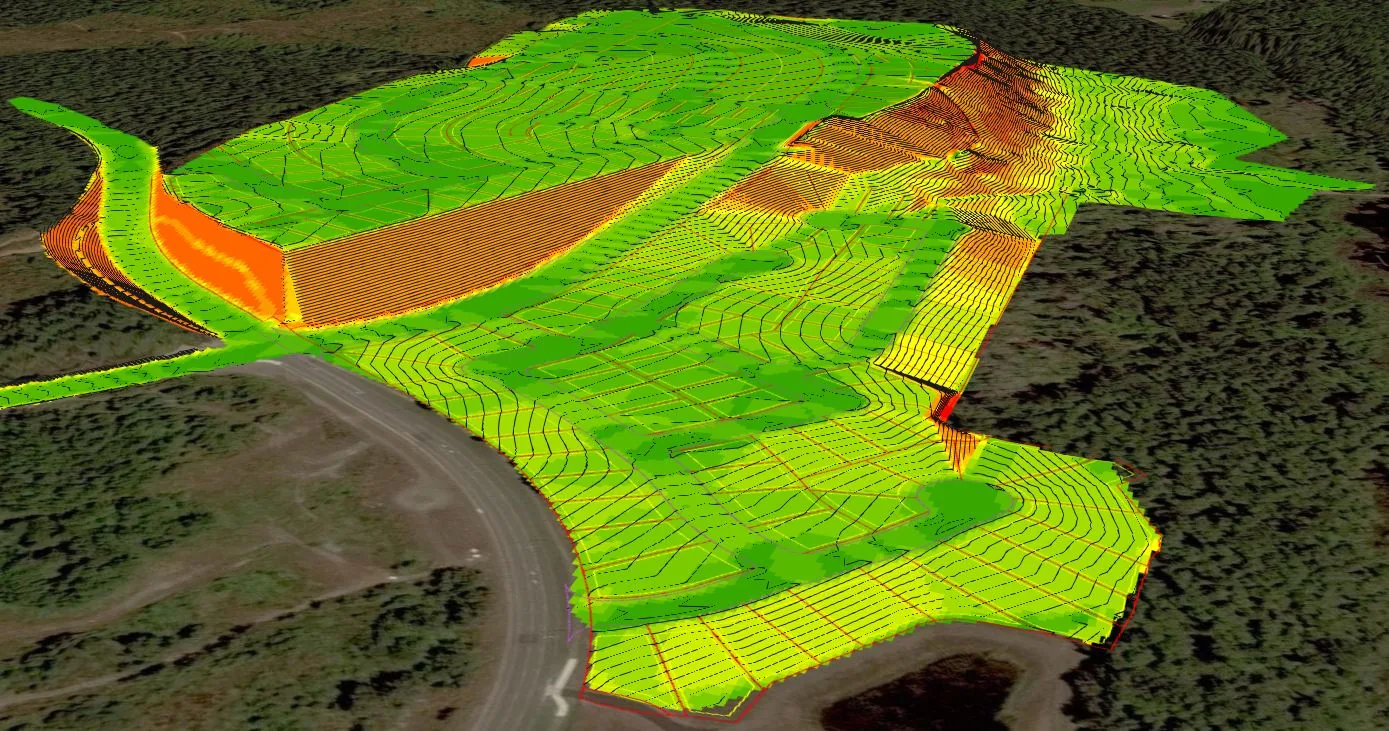
With the exploration data, I map out different strata layers within the deposit, identifying various quality zones of aggregate. By classifying these zones I can better determine the economic value of each area. Using interpolation and geological modeling techniques, I generate a 3D model of the deposit, classifying it by quality.
Having sufficient and high-quality data is critical to quantify mineable aggregate reserves. It reduces uncertainty and provides a higher resolution on the boundaries and quality transitions within the deposit. More data points lead to a more accurate model, enabling better predictions for reserve estimation. This accuracy is fundamental when calculating mineable reserves, as it impacts everything from the project's feasibility to the cost-benefit analysis of various mining methods.
How to: Basic Calculation
A very basic reserves calculation might look like this:
- 1Volume: 100 Acres * 43,560 sq feet per acre * 50 feet deep = 217,800,000 cubic feet
- Convert to Cubic Yards: 217,800,000 cubic feet / 27 cubic feet per 1 cubic yard = 8,066,666 Cubic Yards
- Calculate Overburden Volume: 100 Acres* 43,560 sq feet per acre * 1 feet deep = 4,356,000 cubic feet / 27 cubic feet per 1 cubic yard = 161,333 cubic yards Overburden
- Subtract Overburden: 8,066,666 cubic yards - 161,333 cubic yards = 7,905,333 cubic yards
- Convert to Tons: 7,905,333 Cubic Yards * 21.7 tons/ cubic yard = 13,439,066 tons
- Subtract Waste: (13,439,066 tons *.073) - 13,439,066 tons = 12,498,331 tons
A more accurate reserves calculation will take into account final grade slopes and will segment the reserves by grain size or hardness. Segmentation of the reserves could be used to then value the reserves based off the future value of products that could be produced and sold. For example, if 50% of a sand and gravel deposit is sand and 50% is gravel or cobble and sand is selling for $10/ ton while the gravel/ cobble sells for $15/ ton, then the sand should be valued based off the lower expected average selling price while the gravel/ cobble should be valued at the higher. Reach out to learn more or to get help on your next project.
How Geographic Solutions can help
Geographic Solutions supports aggregate operators, landowners, contractors, and investors with permitting, mapping, reserve modeling, market studies, valuation, and due diligence for pits and quarries in Washington and Oregon.